As a staggering number of Americans have or will develop diabetes it is important to look at what has led Americans to a fast passed, junk food diet. “Cheap food is imp
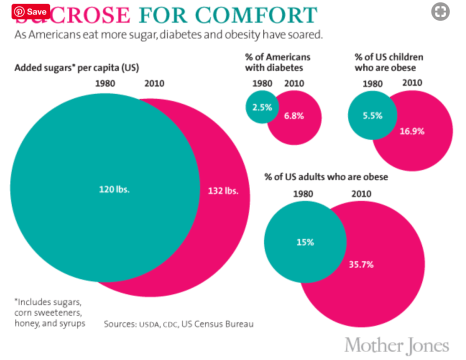
ortant to capitalism because it allows wages to be lower (and thus profits to be higher) and yet leave workers with more disposable income available to buy other commodities”[1]. These diets often include large amounts of sugar, which are generally deemed as unsafe by most researchers. The increase in sugar consumption is, in part, contributed to the idea that sugar is addictive[2]. “The addictive quality of sugar can be compared to that of cigarettes”[3].Consumers’ desire for sugar can be attributed to the marketing power that the sugar industry has.
The Big Sugar industry has fought tooth and nail and invested millions of dollars for decades to contradict negative claims against sugar consumption[4]. For example, “In the mid-1990s, with funding from the Mars Company, Hollenberg set out to prove that what protected the Kuna from heart disease was chocolate”[5].The research done by Hollenberg was later shown to have many errors in his research and therefore cannot necessarily be taken as fact.
Hollenberg is not, however, the only researcher to say chocolate provides us with health benefits. Throughout history many have believed that chocolate can be used for medical and therapeutic needs. “Surely, it is chocolate as a functional food that recognizes and generate interesting physiological effects, likely to promote or maintain health, and therefore chocolate as medi-food,”[6]. Today, though there is still some debate studies have been more conclusive. “Many of the beneficial effects of chocolate are associated with the antioxidant effects of the polyphenols contained in cocoa”[7]. Other benefits of chocolate consumption include lowered blood pressure, cognitive function, better moods, and nerve protection[8].
Even though chocolate may have health benefits, like anything it should only be consumed in moderation. As research continues to advance and elaborate on the sugar and chocolate phenomena we will develop a better understanding of the risks and benefits. Regardless, industry giants will still continue to push us towards the sweeter diets. Overall, the story of chocolate and sugar does not end here.
[1] Robert Albritton, Between Obesity and Hunger – The Capitalist Food Industry (2012), 343
[2] Robert Albritton, Between Obesity and Hunger – The Capitalist Food Industry (2012), 344
[3] Robert Albritton, Between Obesity and Hunger – The Capitalist Food Industry (2012), 344
[4] (Taubest and Kearns Couzens, 2012)
[5] James Howe, Chocolate and Cardivascular Health-The Kuna Case Reconsidered (2012), 45
[6] Donatella Lippi, History of Medical Use of Chocolate (2013), 13
[7] Margarida Castell, Francisco Jose Perez-Cono, and Jean-Francois Bisson, Clinical Benefits of Cocoa – An Overview (2013), 266
[8] Margarida Castell, Francisco Jose Perez-Cono, and Jean-Francois Bisson, Clinical Benefits of Cocoa – An Overview (2013), 267-270

 Cuyagua Unit Blog